The Monkey King’s Operating System: China’s Quantum Stack and the Quantum-Learning Mirage
China open-sourced a quantum operating system and put a 72-qubit machine online for the world to use. Meanwhile, quantum neural networks promise to revolutionize deep learning. One of these stories is real progress. The other is mostly a barren plateau.
- What “Quantum Operating System” Does and Doesn’t Mean
- The Hardware Underneath Is Genuinely Good
- The Tell Is in the Competition They’re Running
- Quantum Neural Networks: What They Actually Are
- The Barren Plateau: Where Quantum Deep Learning Goes to Die
- The Dequantization Bombshell
- The Community Isn’t Buying It Either
- So Is Any of It Real? The Honest Case
- What This Means
In the sixteenth-century novel Journey to the West, Sun Wukong, the Monkey King, is born from a stone egg, learns to travel 108,000 li in a single somersault, and plucks a hair from his body to conjure a thousand copies of himself. He is clever, irreverent, and prone to overstating his own importance to the Jade Emperor. So when Origin Quantum, a company spun out of the University of Science and Technology of China (USTC) in Hefei, named its flagship superconducting quantum computer Origin Wukong, the allusion was not subtle. A machine that exists in many states at once, that promises to leap over classical computation in a single bound, and whose press releases sometimes outrun its physics. The Monkey King is, if anything, an uncomfortably apt mascot.
The news hook is real and worth taking seriously. In February 2026, Origin Quantum released Origin Pilot, the system software that schedules and runs jobs on its quantum hardware, for free public download. The Anhui Quantum Computing Engineering Research Center, which announced it through the state newspaper Global Times, called it the world’s first quantum computer operating system you can actually download and deploy locally rather than just rent through a cloud.1 It underpins the company’s third-generation superconducting machine, Origin Wukong (a 72-qubit processor that has been online for remote public access since 2024), and the company says it has handled millions of remote computing tasks from users in dozens of countries. That is a genuine piece of infrastructure, and it sits inside a Chinese quantum hardware program that is, by any honest measure, one of the two or three best in the world.
But “China’s new quantum OS” arrived in my feeds wrapped in a second, much larger claim: that this hardware, combined with quantum neural networks and quantum deep learning, is about to deliver an AI revolution that classical GPUs cannot match. That second claim is where the gap between the press release and the physics is widest, so it’s where I want to spend most of this essay. I have written before about what quantum computing actually is and where it actually stands; this is the companion piece about the software and machine-learning layer, and specifically about why “quantum AI” is the part of the field where you should keep one hand on your wallet.
The short version: the hardware is impressive and the operating-system work is real engineering. The quantum-machine-learning story is mostly a barren plateau, flat and vast and discouraging once you actually try to walk across it.
What “Quantum Operating System” Does and Doesn’t Mean
When a normal person hears “operating system,” they think Windows, Linux, macOS: a sprawling thing that manages memory, schedules processes, talks to your disk and network, and gives applications a stable world to run in. The phrase “quantum operating system” smuggles in that whole mental model, and that is where the trouble starts. There is a recurring, genuinely useful argument on Hacker News that a quantum computer doesn’t need an operating system in that sense at all. As one commenter (hannob) put it, the whole framing “starts from a very wrong assumption,” the idea that “in the future we’ll just replace classical computers with quantum computers.”2 You will not boot your laptop into a quantum OS. Quantum processors are accelerators, not general-purpose computers; they’re far closer to a GPU or an FPGA than to a CPU. You hand them a carefully prepared circuit, they run it a few thousand times, and they hand you back a distribution of measurement outcomes.
So what is Origin Pilot, stripped of the marketing? It’s the control and scheduling layer that sits between users and the physical chip. A real superconducting quantum processor is a fussy, drifting analog device that needs near-constant recalibration; its qubits decohere in microseconds and its gate fidelities wander as the dilution refrigerator’s temperature and the control electronics drift. The genuinely hard, genuinely valuable software problems are:
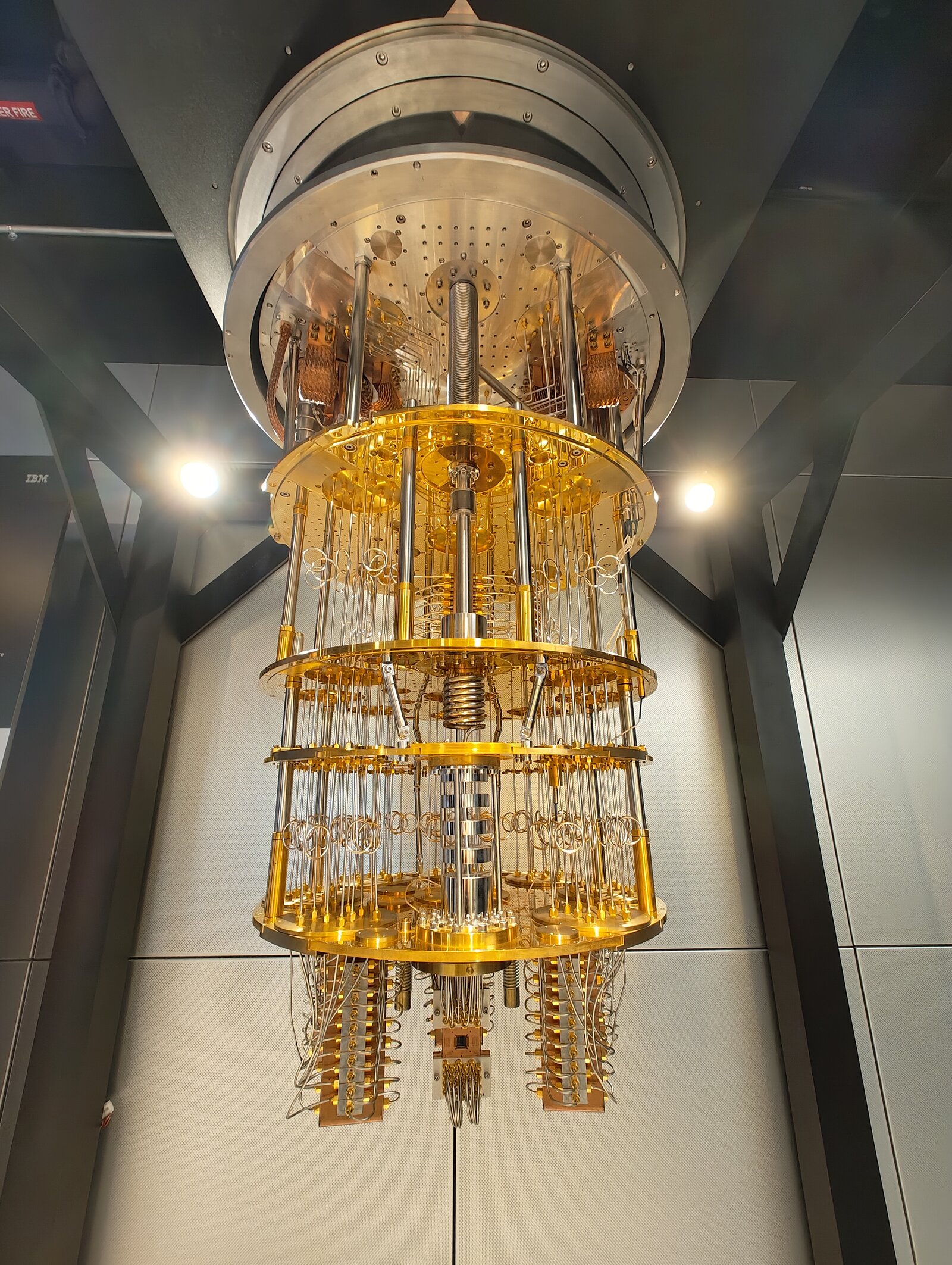
A quantum computer is mostly this: the gold “chandelier” is a dilution refrigerator that cools the chip to near absolute zero, with layers of wiring carrying microwave control pulses down to the qubits at the bottom. The actual processor is a fingernail-sized chip; everything else keeps it cold and calibrated. Photo: OJB Quantum, CC BY 4.0.
Calibration management. Continuously measuring and correcting qubit frequencies, gate pulses, and readout thresholds so the chip stays usable.
Job scheduling and multi-tenancy. When thousands of users worldwide submit circuits to one physical machine, something has to queue them, allocate qubits, batch the shots, and return results. This really is an operating-system-flavored problem: resource allocation under contention.
Compilation and transpilation. Mapping an abstract circuit onto the chip’s actual connectivity graph, inserting SWAP gates, and optimizing for the hardware’s native gate set and error profile.
Error mitigation. Squeezing signal out of noisy results via techniques like zero-noise extrapolation, since true error correction is still mostly out of reach.
This is exactly the set of problems IBM solves with Qiskit Runtime, Google with Cirq, Amazon with Braket, and Xanadu with their photonic stack. Origin Pilot is China’s entry in that category, and you don’t have to take my word for what it does: Origin Quantum’s own marketing lists “Six Core System Capabilities”, and every one of them is control-plane work. Multi-backend access. Multi-user scheduling. Hybrid task management. Compilation orchestration. Resource monitoring. Noise correction. That’s a scheduler and a calibration manager, described in its own words. Open-sourcing it is still a real move: it lowers the barrier for Chinese universities and companies to build on domestic hardware rather than depending on IBM’s or Google’s clouds, and the local-deployment angle (you download it, you don’t just rent cloud time) is genuinely different from what Western vendors offer. The achievement is sovereignty and access, not a new computational paradigm. Calling it an “OS” oversells the abstraction but undersells the actual engineering, which is the harder and more interesting thing.
The Hardware Underneath Is Genuinely Good
It would be a mistake to let skepticism about the word “OS,” or about “quantum AI,” bleed into dismissing the Chinese hardware program. It is excellent, and pretending otherwise is the kind of complacency that has burned the West before. The group at USTC led by Pan Jianwei, sometimes called China’s “father of quantum,” and Lu Chao-Yang has produced two of the most cited quantum-supremacy demonstrations in the field, on two completely different hardware platforms.
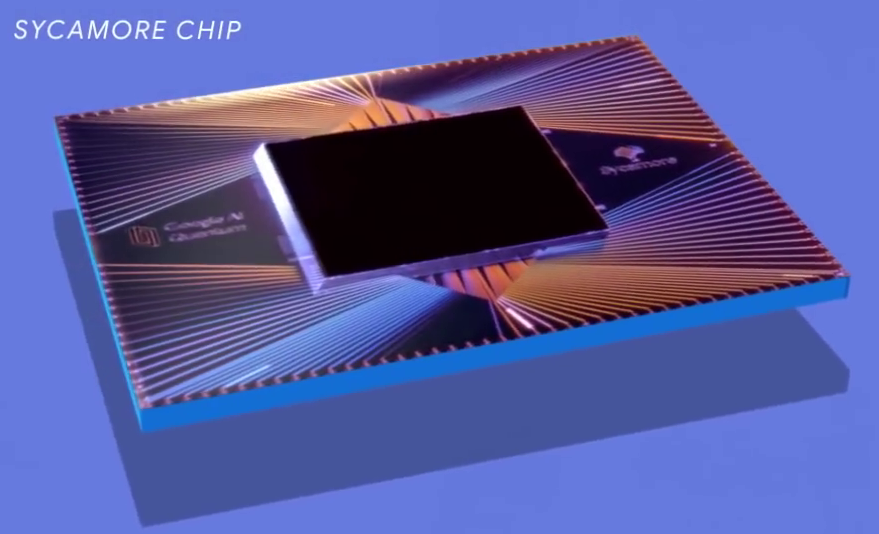
A superconducting quantum processor of the kind used in the Sycamore/Zuchongzhi class of machines. The qubits live on the chip at the center; almost everything else is wiring and shielding. Photo: Google, CC BY 3.0.
The first is Jiuzhang, a photonic quantum computer announced in Science in December 2020. Where Google’s Sycamore used superconducting loops as qubits, in Jiuzhang the photons themselves are the qubits. It performed Gaussian boson sampling, detecting up to 76 photons, in about 200 seconds, a task the team estimated would take a classical supercomputer an absurd amount of time.3 That is a fundamentally different and harder-to-build machine than the superconducting devices everyone else was racing on, and China built it first.
The second line is the Zuchongzhi superconducting processors, the direct competitors to Google’s Sycamore. By 2021, Zuchongzhi 2.1 ran random-circuit sampling on 60 qubits with 24 cycles. In 2025, the team published Zuchongzhi 3.0, a 105-qubit processor, in Physical Review Letters under the title “A New Benchmark in Quantum Computational Advantage with 105-qubit Zuchongzhi 3.0 Processor” (Phys. Rev. Lett. 134, 090601).4 That puts China’s superconducting qubit counts in the same league as Google and within shouting distance of IBM’s roadmap. One HN commenter captured the dynamic bluntly: “From talks I have watched, China is dumping money into quantum computing because Jian-Wei Pan and his team are genius. I don’t think China has the same problems we do that people are worried about ‘hype.’”
The funding asymmetry is real and frequently noted. As far back as the late 2010s, HN users were pointing out that “China is funneling $10B into a single quantum lab” while comparable US federal spending was a fraction of that.5 Whether or not those exact figures hold, the strategic commitment is not in doubt: China treats quantum as national infrastructure, the way it treated high-speed rail and 5G. The Origin Wukong remote-access platform, putting a real 72-qubit machine on the public internet for anyone in the world to run jobs on, is a flex of exactly this kind. It says: we have the hardware, we have the software stack, and we are confident enough to let you use it.
So: the hardware is real, the OS work is real, the strategic threat is real. Now let’s talk about the part that isn’t.
The Tell Is in the Competition They’re Running
If you want to know what a company actually believes its technology is for, look at what it incentivizes people to build with it. Origin Quantum isn’t just shipping an OS; it’s running a whole ecosystem of contests to pull developers onto the platform. There’s the 2026 CCF Quantum Computing Programming Challenge “OriginQ Cup”, run with the China Computer Federation, split into University, Professional, Challenge, and Open-Source Innovation tracks (the last one explicitly about contributing code to their pyqpanda-algorithm project). There’s the Wukong Research Incentive Program, which since 2024 has handed out free quantum runtime and cash “paper rewards” to academics who publish results on the machine. This is smart, patient ecosystem-building. It’s the talent-pipeline version of open-sourcing the OS, and the West should pay attention to how deliberate it is.6
Here’s the part that made me laugh, though. One of the flagship contests, the 2026 CIC “Wukong Cup” Application Track, set its challenge as improving image-classification accuracy on a fixed baseline variational quantum circuit. Read that again. The headline application they chose to showcase quantum machine learning is classifying images on a quantum neural network, which is the single most picked-over, most-dequantized, most-barren-plateau-prone task in the entire field. It’s the quantum-ML equivalent of demonstrating a new programming language by writing FizzBuzz, except FizzBuzz actually works. They’re steering a national talent competition straight at the wall that the field’s own researchers have spent eight years documenting. Which is the perfect segue, because we should talk about that wall.
Quantum Neural Networks: What They Actually Are
Strip away the branding and a quantum neural network is, in almost all current practice, a parameterized quantum circuit, also called a variational quantum circuit or an ansatz. You build a circuit out of quantum gates, some of which have free parameters (rotation angles, essentially). You feed in data by encoding it into the initial quantum state, run the circuit, measure the output, and compute a loss. Then, and this is the part people miss, you hand the gradient back to a perfectly ordinary classical optimizer (Adam, gradient descent) running on a normal computer, which nudges the angles and tries again. The “neural network” analogy is loose: the tunable rotation angles play the role of weights, and the layered gate structure plays the role of layers. That’s about where the resemblance ends.7
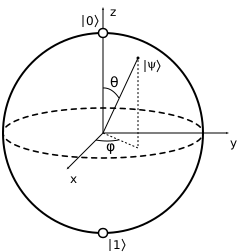
The Bloch sphere: the standard way to picture a single qubit’s state as a point on a sphere. The “rotation angles” a quantum neural network trains are literally rotations of vectors like this one. Diagram: Smite-Meister, CC BY-SA 3.0.
The motivating intuition is seductive and you have heard it a hundred times: n qubits span a 2n-dimensional state space, so a 300-qubit network “explores more states than there are atoms in the universe,” and surely that exponential richness must translate into exponential learning power. This is the same intuition that powers most quantum hype, and it is wrong for the same reason every time. As I discussed in the quantum-computing primer, having access to an exponentially large state space does you no good unless you can (a) get your data into it efficiently and (b) get a useful answer out of it via measurement, and measurement collapses that gorgeous superposition down to a handful of classical bits. The exponential space is real; your access to it is a soda straw.
There is a whole zoo of these models: quantum convolutional neural networks, quantum Boltzmann machines, quantum kernel methods, quantum generative adversarial networks. The frameworks to build them are mature and pleasant to use, like PennyLane from Xanadu, TensorFlow Quantum from Google, and Qiskit Machine Learning from IBM. A working ML engineer on HN listed “Cirq, QISkit, Pennylane” right alongside “PyTorch, JAX, Tensorflow” in their skills, which tells you the tooling is real and people are genuinely building with it. The frameworks are not the problem. The problem is that when you try to train these things at any interesting scale, the ground gives way beneath you.
The Barren Plateau: Where Quantum Deep Learning Goes to Die
In 2018, a team at Google (McClean, Boixo, Smelyanskiy, Babbush, and Neven) published a paper in Nature Communications with a title that has become a load-bearing piece of the field’s self-awareness: “Barren plateaus in quantum neural network training landscapes.” The result is devastating and elegant in equal measure.8
Here is the result in plain language. As you add qubits to a sufficiently expressive quantum neural network, the gradient of the loss function (the signal that tells your optimizer which way to nudge the parameters) vanishes exponentially fast. The training landscape flattens into an enormous, near-featureless plateau. Everywhere you stand, the slope is essentially zero, so the optimizer has no idea which direction to step. To even detect a slope, you’d need exponentially many measurement shots, which destroys any speedup you imagined you had. Classical deep learning works because high-dimensional loss landscapes, for all their pathology, have usable gradients almost everywhere; backpropagation through a billion-parameter transformer finds a direction to descend. The quantum analogue, past a modest scale, hands you a desert.
This is not a hardware problem that better qubits will fix. It is a structural, information-theoretic property of the way these circuits concentrate measure in high dimensions. You can dodge it with clever circuit design (local cost functions, shallow circuits, careful initialization, problem-specific ansätze), but every dodge narrows the model back down toward something a classical computer could have done. The plateau is the field’s central, stubborn fact, and any “quantum deep learning will beat GPUs” pitch that doesn’t mention it is selling you something.
The Dequantization Bombshell
The second body blow is subtler and, to my mind, even more damaging to the hype. It comes from Ewin Tang, who as an 18-year-old undergraduate at UT Austin, working under Scott Aaronson, did something that quietly gutted one of quantum ML’s flagship claims.9
For years, the quantum recommendation-system algorithm (think: the math behind “customers who bought this also bought”) was held up as a clean example of an exponential quantum speedup for a machine-learning task. Tang showed that the speedup was largely illusory: once you give a classical algorithm the same kind of efficient sampling access to the data that the quantum algorithm quietly assumed, the classical algorithm nearly catches up. She then did it again for other quantum ML algorithms, including low-rank matrix problems and principal component analysis. This launched an entire subfield of “dequantization”: taking a claimed quantum-ML speedup and constructing a classical algorithm that matches it. A sobering number of the field’s marquee results have since been dequantized.
The lesson generalizes painfully. Many quantum-ML speedup claims rest on an apples-to-oranges comparison: the quantum algorithm assumes you can load classical data into quantum states in “quantum RAM” (QRAM) at no cost, an assumption that is itself an unsolved hardware problem of enormous difficulty. Strip that assumption, or grant it to the classical side too, and the advantage often evaporates. As Scott Aaronson has warned for over a decade, the field is rife with this pattern, which is why the most-upvoted HN reference on the subject is simply a link to Aaronson “advis[ing] against getting excited by quantum machine learning.”
The Community Isn’t Buying It Either
What strikes me reading through practitioner discussions is how cynical the experts are about quantum AI specifically, far more than the public coverage suggests. These are not anti-quantum cranks; they are people who use the tools. The recurring theme is that “quantum AI” has become the field’s tell for marketing over substance.
The sharpest version came from a commenter (latenightcoding) reacting to a Google Quantum AI paper: “the fact that this is from google ‘quantum AI’ makes me doubt the legitimacy. They are really ruining their reputation with all the absurd quantum stuff they have been publishing, e.g: their wormhole stuff and a lot of quantum neural networks bs.” Another (kromem) was even blunter, saying something marketed as “quantum AI” can be “about as ‘AI’ as snake oil health products are ‘quantum.’” When practitioners reach for the snake-oil comparison about a subfield’s branding, that is a signal worth heeding.10
There’s also a useful, deflating observation about how the term gets abused. As one person (amitav1) who was “dipping my toes into quantum machine learning” clarified, the public hears “machine learning on quantum hardware” when what researchers often actually mean is “machine learning for quantum computing on classical hardware,” ie., using ordinary neural nets running on GPUs to help calibrate, control, and error-correct quantum devices. That application is real, valuable, and entirely classical. It is also not what anyone means when they sell you “quantum deep learning.”
And then there’s the LinkedIn-résumé tell. A commenter (roadside_picnic) recalled that before LLMs became the obvious next big thing, “I would see ‘quantum machine learning’ on people’s profiles,” the same opportunistic title-chasing that later migrated to “prompt engineer” and “AI agent architect.” The buzzword moved on; the underlying difficulty did not.
So Is Any of It Real? The Honest Case
I don’t want to overcorrect into pure dismissal, because there is a defensible version of quantum machine learning. It’s just much narrower and less GPU-threatening than the pitch.
Quantum data, not classical data. The most intellectually honest case for QML is learning on quantum data: states produced by quantum experiments, quantum sensors, or other quantum computers. Here you sidestep the data-loading bottleneck entirely, because the data is already a quantum state. A 2021 Nature Communications paper by Huang et al, “Power of data in quantum machine learning,” and subsequent “quantum advantage in learning from experiments” work, made a careful, provable case that for some tasks involving quantum data, quantum models can learn from exponentially fewer samples than classical ones. This is real, and it is the part of the field I’d bet on. But notice it has nothing to do with classifying cat photos or training a chatbot.
Quantum simulation as the killer app. As one commenter (maxboone) noted, “the origins of quantum computing give it a clear use: simulation of many-body systems.” Chemistry, materials science, drug binding: domains where the thing you’re simulating is itself quantum mechanical. If quantum computers ever earn their keep, this is almost certainly where, and ML-flavored variational methods like VQE (the variational quantum eigensolver) are a plausible tool there. But again, this is quantum computers doing quantum problems, not eating classical deep learning’s lunch.
Inspiration, not acceleration. Tang’s dequantization work had a beautiful silver lining that one commenter (hershkumar) flagged: “the development for quantum algorithms has led to many advances in classical computing.” Trying to build quantum algorithms forces you to understand the linear-algebraic structure of a problem so deeply that you often discover a better classical algorithm along the way. Quantum thinking has been a genuinely productive source of classical algorithms. That’s a real contribution; it’s just the opposite of the marketing.
What This Means
Let me separate the threads I’ve tangled together, because they pull in different directions and the headlines mash them into one.
China’s quantum hardware program is real and world-class. Jiuzhang, the Zuchongzhi line up to 105 qubits, and a 72-qubit machine on the public internet are not vaporware. If you care about strategic competition in computing, this is a place where the US lead is thin to nonexistent, and the funding asymmetry suggests it could narrow further. Take it seriously.
Origin Pilot is real, useful infrastructure, and mislabeled. Open-sourcing a quantum control-and-scheduling stack is a genuine contribution to the ecosystem and a smart sovereignty play. It is not an “operating system” in the sense the word conjures, and it does not change what the underlying hardware can compute. It’s plumbing. Good plumbing, but plumbing.
Quantum neural networks and quantum deep learning are the weakest link in the chain. Between the barren plateau (you can’t train expressive quantum networks at scale), dequantization (many claimed speedups vanish under fair comparison), and the data-loading bottleneck (you can’t get classical data into the machine cheaply), the case that quantum computers will revolutionize the kind of machine learning that actually matters commercially (the GPU-hungry, classical-data-devouring kind that gave us LLMs) ranges from unproven to actively refuted. The honest applications, learning on quantum data and quantum simulation, are real but narrow, and they don’t compete with your H100 cluster.
The thing I keep coming back to is how cleanly this maps onto the pattern I described in the quantum-computing primer: the physics is genuinely revolutionary, the engineering is genuinely hard and genuinely advancing, and the applications most people get excited about are precisely the ones the field’s own best researchers are most skeptical of. “China’s new quantum OS will power a quantum-AI revolution” is three true-ish nouns and one false verb. The OS is real. The quantum hardware is real. AI is real. The arrow connecting them, the claim that this stack is about to out-learn classical deep learning, is the Monkey King boasting to the Jade Emperor. Impressive somersaults. Still 108,000 li short of heaven.
I’d watch the hardware closely and treat every “quantum AI breakthrough” headline as guilty until proven innocent. So far, the field’s own experts are the ones holding the line, and when the people building the tools are the loudest skeptics about the marketing, that’s usually the tell that the marketing is the problem.
Origin Wukong and the Origin Pilot quantum operating system are products of Origin Quantum Computing Technology (Hefei); see the company’s own Origin Pilot download page, its events and competitions page, and the Quantum Insider report on the Feb 2026 open-source release. The hardware results discussed include Jiuzhang (Zhong et al, Science, 2020) and Zuchongzhi 3.0 (Phys. Rev. Lett. 134, 090601, 2025), both from Pan Jianwei’s group at USTC. The skeptical results are McClean et al, “Barren plateaus in quantum neural network training landscapes” (Nature Communications, 2018); Ewin Tang’s dequantization work (2018–2019); and Huang et al, “Power of data in quantum machine learning” (Nature Communications, 2021). For the broader context, see Quantum Computing: What It Actually Is, Where It Actually Stands.